Showing posts with label horses in history. Show all posts

Monday, May 13, 2019

Origination of Horse Breeds in the American Colonies

Dr Deb Bennett just published another wonderful article on breed origination. 2016 September's issue of Equus Magazine includes her article "Horses of the American Colonies." Because of the lack of good roads, most of the horses in the colonies in the early 1600s were short, round bodied, muscular amblers. Using Hobbies, or small gaited horses from England/Ireland mixed in with some other breeds, Captain Hull in Rhode Island started breeding Narragansettl Pacers in the late 1600s, the first American breed. These horses were sold to the American south and exported to the Indies and other areas for plantation use. 

Dr. Bennett goes on to explain how the founding strain of imported horses led to the development of later American breeds. "All the riding horse breeds with roots in the original 13 colonies--including the Morgan, American Standardbred, Tennessee Walking Horse and the American Quarter Horse--descend from four strains first imported from Europe during the 17th century These were the English-Irish Hobby, the Breton-Canadian, the Scottish Garron and the Dutch (Flenish) "Hartdraaver." Dr. Bennett goes on to explain that Hartdraaver is a period name for the Friesian. English Thoroughbreds did not come into the mix until after the revolutionary war.

Note Hobbies, which no longer exist, looked like the contemporary Kerry Bog or Icelandic horse. I am endlessly amused visualizing Paul Revere tolting an Icelandic-looking horse, a chestnut with flaxen mane and tail of course, on his Midnight Ride through Massachuchetts--which may be more historically accurate than a trot or gallop.

Friday, May 10, 2019

Ambling Horses in the American Colonies

Dr Deb Bennett just published another wonderful article on breed origination. September's issue of Equus Magazine includes her article "Horses of the American Colonies." Because of the lack of good roads, most of the horses in the colonies in the early 1600s were short, round bodied, muscular amblers. Using Hobbies, or small gaited horses from England/Ireland mixed in with some other breeds, Captain Hull in Rhode Island started breeding Narragansettl Pacers in the late 1600s, the first American breed. These horses were sold to the American south and exported to the Indies and other areas for plantation use. 

Dr. Bennett goes on to explain how the founding strain of imported horses led to the development of later American breeds. "All the riding horse breeds with roots in the original 13 colonies--including the Morgan, American Standardbred, Tennessee Walking Horse and the American Quarter Horse--descend from four strains first imported from Europe during the 17th century These were the English-Irish Hobby, the Breton-Canadian, the Scottish Garron and the Dutch (Flenish) "Hartdraaver." Dr. Bennett goes on to explain that Hartdraaver is a period name for the Friesian. English Thoroughbreds did not come into the mix until after the revolutionary war.

Note Hobbies, which no longer exist, looked like the contemporary Kerry Bog or Icelandic horse. I am endlessly amused visualizing Paul Revere tolting an Icelandic-looking horse, a chestnut with flaxen mane and tail of course, on his Midnight Ride through Massachuchetts--which may be more historically accurate than a trot or gallop.

Saturday, December 1, 2018

Were Women the First Cave Artists

I think that women always have had a special relationship with horses, which includes drawing and painting them. While researching the clip on animated paleolithic cave art, I came across the research of Dean Snow at Pennsylvania State University. He proposes that about 75% of the artists drawing animals in such caves as Altiamira Cave, Spain, and Lascaux Cave, France, circa 30,000 to 17,300 years ago, were women. Up to this time, most researchers and art historians assumed all cave artists were men-- probably involved in the creation of hunting magic. 

Snow bases his proposal on the way men and women's hands differ. Usually the length of the index finger and the ring finger are roughly the same for women. The ring finger is longer than the index finger on most men. Hand stencils (pigment is flicked around the hand to create an outline) frequently occur as part of paleolithic cave art. Analysis of the outlines of these hands is how Snow determined that most of the artists were women, possibly female shaman involved in hunting magic.


Of course, there are alternative ways to analyze the same date. R. Dale Guthrie analyzed the measurements of palm widths and thumbs to conclude that the artists were adolescent boys interested in powerful animals and big busted fertility goddesses (think Venus of
Willendorf).

Photo source: Pech Merle Cave Painting Wikipedia

http://news.nationalgeographic.com/news/2013/10/131008-women-handprints-oldest-neolithic-cave-art/

Monday, October 1, 2018

Horses of St Marks Basilica in Venice

One last post about Roman chariot racing....the horses of St. Marks Basilica in Venice (the originals are now inside the church) represent a Quadriga, or 4-horse team, used in Roman victory parades or chariot racing. These gorgeous sculptures are copper, not bronze and were probably made in the Roman Empire circa second or third century AD. Enjoy the video showing the beauty of these golden horses and the miraculous story of their survival as they were moved around Europe and Asia by conquest and war.

Tuesday, September 25, 2018

Hobby Horse as Roman Chariot Horse

The latest remake of Ben Hur premiered last year. Who can forget the chariot racing scene from the 1959 version starring Charlton Heston? And how is Pamela going to relate Ben Hur to Icelandic horses?

Dr. Deb Bennett wrote an article in Equus magazine identifying the most historically important horse breed ever as the Hobby Horse. To briefly summarize...around 1500 to 1000 BC, Phoenician traders were taking horses with the gaited gene to trade for tin in what is now Great Britain. These gaited stallions were crossed with native ponies who had the speed gene to form the foundation for what became the Hobby Horse (in appearance think Icelandic or Kerry Bog). (Certainly the Norse would have taken some hobby horses from Northern England and Scotland to Iceland to contribute to the foundation of the Icelandic horse.)

Speed plus gait was an extremely desirable combination so the Romans (circa 43 AD to 410 AD) took hobby horses back to Italy for chariot races. Horses for chariot racing were bred from stock primarily from what is now Spain, Libya (northern Africa), and other areas. The training of Roman chariot racing started at age 5 and successful horses were know to race into their 20s.


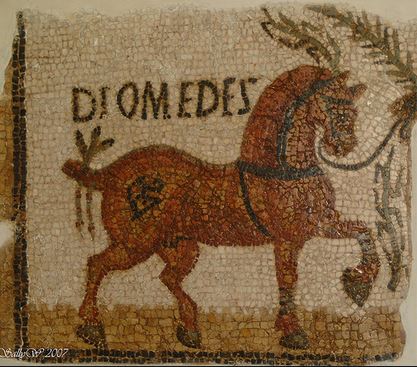
As you can see by the Roman mosaics, chariot racing horses were much smaller than the horses we see in the movies. Some mosaics even depicted portraits of individual horses and their names. You can easily compare the more compact shapes of the hobby horses types versus the lighter boned horses from Spain and Africa.

So to be more historically accurate from an appearance point, some of the charioteers in Ben
Hur movies should be driving Icelandics representing the Hobby horse; and some, shorter Andalusians. Wouldn't that be a race to see?

Thursday, April 5, 2018

Peasants Revolt of 1381 Reenactment

During the Middle Ages, wealthy and noble travelers rode ambling horses. Knights had their squires lead or perhaps ride their destriers or warhorses because of the discomfort of riding a trot over long distances--especially since posting to the trot wasn't discovered until late 1700s.

Tony Robinson's special on the Peasants Revolt of 1381 is fascinating. As part of the investigation, Mike Lodes (not sure of spelling) leads relays of horses to re-enact the peasant leaders' ride from Canterbury to London. For most of the trek, riders are mounted on what looks like draft or draft crosses. But at minute 45:26, Mike and his team "put on a sprint thanks to some authentic medieval technology, they switch horses." The team mounts the much smaller Icelandic horses, which are close to the medieval amblers considering their history, and ride a fast 18 mile amble with the horses just as "fresh and spritely" at the end as when they started. Mike demonstrates what an amble is and why it would be more comfortable for horse and rider over long, rough roads. At 13 to 14 hands, Icelandics are much closer in height to the average horse ridden in the early Middle Ages.

Tuesday, April 3, 2018

Link to My Equus Article "Riding with Theodore Roosevelt"

Pressreader has selected my Equus article for international distribution.  You can read the entire article about Theodore Roosevelt (without most of the illustrations) via this link. Note there are a lot of typos in this version due to conversion from print to online.

https://www.pressreader.com/usa/equus/20180401/282510069074962

Friday, December 29, 2017

Christmas, ambling horses, and medieval art

Here's a post about Christmas, ambling horses, and medieval art--what could be better except a real pony under the Christmas tree. The Three Wise Men rode gaited horses for some part of their journey.
In addition to--or as a replacement to--a trot, gaited horses exhibit an intermediate gait between a walk and canter, now known as rack, amble, single foot, tolt, running walk, fino fino depending on the horse breed. This 4-beat gait can be as smooth as silk to ride at speed as opposed to the up-down motion of the 2-beat trot. In medieval art (and the art of many other cultures) you can tell whether the horse is trotting or ambling by the position of the legs. If the diagonal legs are moving, then the horse is trotting. If the lateral legs on the same side are moving (observe to see if that back hock is cocked), then horse is ambling. Ambling horses or palfreys were especially prized in the Middle Ages since this smooth gait was very comfortable to ride for long distances.

The first image is the three wise kings depicted on the Catalan Atlas, drawn by Cresques Abraham, around 1375. Abraham created a series of maps showing the universe and the world as known at that time. This particular map showed the known world with Jerusalem at its center. The translation of the map inset explains "This province is called Tarshish, from which came the Three Wise Kings, and they came to Bethlehem in Judaea with their gifts and worshipped Jesus Christ, and they are entombed in the city of Cologne two days journey from Bruges." Tarshish was supposedly located in Spain. And I love the dappling of these palfreys.

The second image is a Limoges box reliquary dating from around 1200 AD. It depicts the story of the
Three Wise Men. The side displays the Adoration of the Magi and the top shows their journey to find Baby Jesus. If you enlarge the magnification, you will see that the two left riders are on amblers whereas the rider to the far right is just breaking into the canter perhaps because he first caught sight of the star over the stable in Bethlehem--which is a lovely way to indicate motion in a static medium.
Both images and their explanation are from Wikipedia.

Monday, December 11, 2017

Jeff Davis--the Quarter Running Horse of General Grant


In the June 2017 edition of Equus magazine, Dr. Deb Bennett wrote an article "Horses of the Civil War." Her focus was on types of horses, their origins, and development of subsequent breeds during this time frame. Of course, she discuses the "appalling slaughter" of horses and men in this conflict.

Source: Library of Congress
My attention was drawn to the photo of Jeff Davis--a captured, 14.2 hand, ambling, black pony that became one of General Grant's favorite riding horses--because of his resemblance to an Icelandic horse. Bennett identifies Jeff Davis as a "quarter running horse," which formed the basis of the American Quarter Horse, and was a mixture of "Thoroughbred, Morgan, Hobby and Narragansett Pacer." She sees a high percentage of Hobby in Jeff Davis. Icelandics and Kerry Bogs are very close cousins of the Hobby which no longer exists as a breed but was important in the development of the Thoroughbred, Morgan, Quarter Horse, and gaited breeds.

Here's a description of Jeff Davis, the pony, from General Grant's son:
"During the campaign and siege of Vicksburg, a cavalry raid or scouting party arrived at Joe Davis' plantation (the brother of Jefferson Davis, President of the Confederacy) and there captured a black pony which was brought to the rear of the city and presented to me. The animal was worn out when it reached headquarters but was a very easy riding horse and I used him once or twice. With care he began to pick up and soon carried himself in fine shape.

At that time my father was suffering with a carbuncle and his horse being restless caused him a great deal of pain. It was necessary for General Grant to visit the lines frequently and one day he took this pony for that purpose. The gait of the pony was so delightful that he directed that he be turned over to the quartermaster as a captured horse and a board of officers be convened to appraise the animal. This was done and my father purchased the animal and kept him until he died, which was long after the Civil War. This pony was known as "Jeff Davis."​"

So if a famous Civil War general, who was known for his riding skills, rode a "pony" then none of us should worry about what folks think when we ride our Icelandics with their "so delightful" gaits.

Sunday, December 3, 2017

What Was It LIke for Horses in the Mines

From 1871 to 1875, 7868 horses were exported from Iceland--many intended for the mines in Scotland and England. Life for horses in the mines was tough, some became blind because they remained underground until they retired. The following tonal video helps us imagine what it took for a horse to enter an environment so unnatural to it--in this case the Allenheads mine entrance in Northumberland, England. The horse sounds are provided by a "happy Icelandic" living in open pastures.
Horse track in Allenheads from sabine vogel on Vimeo.

Wednesday, June 1, 2016

Wendy Williams - The Horse--Part II Evolution


I finally finished Wendy William's The Horse: The Epic History of Our Noble Companion. Her master work includes interviews with researchers studying wild horse behavior, organizers who successfully reintroduced the Przewalsksi or Takhi wild horse to Mongolia, scientists studying equine social behavior, and much more.

Williams writes so vividly that for the first time I read about the evolution of the horse from start to finish--a process involving continental drift, triumph of grass, climate change, plant wax at the bottom of the ocean, and much more.

Below is a photo from the 1905 Scientific American article on the evolution of the horse. It contrasts the phases of a modern horse canter (based on photographs) with how scientists of the time thought the Hyracotheium, a 4-toed horse dating from 56 million years ago in the Eocene period moved. Hyracothenium was assumed to canter like modern horses.

As Williams explains these very early horses lived in a warm, jungle- like environment in which they mushed grapes, browsed on other fodder, and scampered like rabbits. The modern horse canter was millions of years in the future. Plains covered in grass appeared and the horse grew taller, four toes became one toe,evolved to run, and developed the tough teeth needed to graze on silica-based grasses. The eyes moved closer to the top of the head as the teeth took up more room in the jaw.  Brains grew bigger to track and find more dispersed resources.

The evolution of the horse had one benefit important to mankind. As Dr. Martin Fischer, German evolutionary biologist explains, "Horses are actually the only dorsal-stable animal we have. That's why we can ride them." p. 83

Saturday, May 28, 2016

Origin of Western Canadian Horses and Yakut Pony

Just came across this study about the origin of some western Canadian wild horses--stock from the French king, some Spanish, and the Russian Yakut pony.  And the Yakut is distantly related to the Icelandics since the Vikings took some Yakut/Mongolian sourced stock to Iceland at its settlement from 800 to 1000AD.  Who would have ever guessed?

Sunday, May 15, 2016

Hillary Clinton Owned Two Icelandic Horses ---Briefly

The children of Iceland gave Senator Hillary Clinton two Icelandic horses, one of which was named Spadi.  Einar Bollason, Managing Director of Íshestar Riding Tours, was selected to present the horses to Clinton.  As he explains, "It was a big media fuzz and the reporters followed me for days before she came, because the day was kept a secret for security reasons. The only way to escape the journalists was to saddle up my horses and ride into the mountains!" (Interview with, n.d.)

You can view a picture of the presentation of the horses here:


http://www.angelfire.com/az/testryder/images/clintonicelandics.jpg


Then Senator Clinton accepted them with the intent of donating them to the children of the United States.  Senator Clinton gave the horses to Green Chimneys, a non-profit therapeutic and educational center.  (Halberg, 2008, p. 53)  Currently Green Chimneys supports over 300 animals and birds--including horses, camels, llamas, goats, falcons, guinea pigs, hedgehog, rats, cat, and more--used in their therapy programs for emotionally troubled children. 


Spadi was a favorite therapy horse at Green Chimneys. (The second horse died of cancer and Spadi is no longer listed on the Green Chimneys web page.)  One of the young riders Devon  "likes Spadi for a couple of reasons. First, in addition to the usual gaits of walk, trot, canter and gallop, Spadi has a gait called the toelt that is something like the long trotting gait of a Missouri Fox Trotter; very smooth, fast and stable. Devon very much likes that toelt gait. Second, Spadi is the unquestioned herd leader of Green Chimneys' horses, even though compared to American horses like the quarter horse, Morgan, Standardbred or Thoroughbred, he looks no bigger than a tall pony. He has an attitude that says, "I will NOT be intimidated by you, and you WILL do what I tell you." He stands like a rock and stares them down. Finally, the two of them get along; there is a bond between them. Horse people will understand what I mean."  (Junior, 2013)   

You can view a picture of Spadi and his young rider Devon at:

https://www.gunandgame.com/threads/junior-on-horseback.156992/

Now that Hillary and Bill Clinton have their first grandchild, I wonder if they are thinking about getting the young one a pony--perhaps an Icelandic pony.  ;-)


Sources:
http://www.greenchimneys.org/farm/animals/

Halberg, L.  (2008) Walking the Way of the Horse, iUniverse.  

Interview with Einar Bollason at http://www.findaridingholiday.com/ishestar.php

Junior on Horseback (2013).  Found at https://www.gunandgame.com/threads/junior-on-horseback.156992/

Saturday, April 23, 2016

Theodore Roosevelt and the Power of the Sugar Cube


Theodore Roosevelt understood that feeding a well timed treat could help the horse adapt to novel situations.  His young horse Renown was extremely frightened of automobiles encountered during rides in Washington DC.  On one ride the young horse behaved better than expected upon meeting a large red automobile.  “In fact,” as Roosevelt explained, “he behaved so well that I leaned over and gave him a lump of sugar when he had passed the object of terror—the old boy eagerly turning his head around to get it.” 

In the video below, Roosevelt is riding his thoroughbred Sidar.  At the end of the ride, he rewards Sidar with a sugar cube, probably for approaching the huge, scary, oldtime film camera.

Saturday, January 30, 2016

Heavenly Horses and the Emperor Wu-ti

Flying Horse, Wikipedia
Over 2000 years ago, the Chinese Emperor Wu-ti (or Wu of the Han dynasty) tried to purchase the fast and powerful Ferghana horses, Heavenly Horses, from Dayuan in Central Asia.  The Emperor recognized that he needed better breeding stock if his cavalry had any hope of combating the continually invading nomadic Huns mounted on their stocky ponies.  When his offer was refused, he sent an army to march 1000 miles across the dessert to capture these horses. The army returned defeated by battle and the dessert.  The Emperor sent out an even larger, better supplied army which besieged the capital of Ferghana.  The nobles killed their king and sent 3000 horses, including 30 Heavenly horses back as tribute to China with the much depleted Chinese army.

I recently came across this story in Bruce Chatwin's story "Heavenly Horses" in his collection What Am I Doing Here.  Chatwin speculates that these horses were originally Arabians from the Middle East based on contemporary sculptures and the following description: tails sweeping the ground, 'double spined like a tiger' (probably refers to a horse so in shape it has muscles riding above the spine), whiskers to their knees, hooves thick as a wrist,  and sweating blood in the sun.  He also claims that the stocky bodied Hun ponies were descended from the Przwalsky wild horses, which recent mtDNA studies show is false.  All domesticated modern breeds descend from the Tarpan, none from Przwalsky wild horses.

I went to the internet to see what these Heavenly Horses might have looked like.  Much to my surprise, the bronze statue of the flying horse from the East Han dynasty showed up. (Today this statue is one of 64 treasures of China that is so valued it can never leave China for exhibition.)  I have seen copies of this statue used as awards in relation to the Icelandic horse.  Why, because it so wonderful expresses the flying pace gait of the Icelandic horse.    This means the Heavenly Horses were genetically gaited.

We will probably never know the origin of the Heavenly Horses.  But I wonder if centuries later, Vikings picked up some stock  related to the Ferghana horses from their travels in Russia and Asia Minor and took the horses back to Iceland (or Norway and then Iceland).

Sunday, April 12, 2015

What I Learned from Teddy Roosevelt--to appear in Equus Magazine

My article "What I Learned from Teddy Roosevelt" will be published by Equus Magazine!!!!  TR obviously was quite a horseman and had a special relationship with several horses during his life.  Although he never wrote an essay on horsemanship, he sprinkled some fascinating comments about horse training through out his works.  As I read his reflections, I was struck by how relevant these observations were to training and understanding horses today.  The article represents my attempt to compare his methods with what current research indicates are best practices in horse training. I think Teddy Roosevelt would have been very interested in what scientists are finding out about equine learning and behavior.  

For example, Roosevelt understood that feeding a well timed treat could help the horse adapt to novel situations.  His young horse Renown was extremely frightened of automobiles encountered during rides in Washington DC.  On one ride the young horse behaved better than expected upon meeting a large red automobile.  “In fact,” as Roosevelt explained, “he behaved so well that I leaned over and gave him a lump of sugar when he had passed the object of terror—the old boy eagerly turning his head around to get it.”  (Roosevelt, 1919, p. 69)   

Here is a link to a video from the Library of Congress of Teddy, who was in his 50s, riding his horse Sidar at the Roosevelt summer home Sagamore Hill. Notice how he feeds a sugar cube to Sidar, I suspect because the horse may be afraid of the huge camera used in the early 1900s. 


Equus is one of the big 4 magazines on horses and riding.  It is sold by the major bookstores such as Barnes and Noble and at tack stores.  Laura Hillenbrand, who wrote Seabiscuit and Unbroken, is one of the contributing editors.

I even managed to sneak a reference to Icelandic horses into the article.  

Roosevelt, T.  (1919).  Theodore Roosevelt’s Letters to His Children,  New York, Charles Scribner's sons.

Wednesday, October 15, 2014

Gaits of Horses on the Bayeux Tapestry

This Bayeux Tapestry panel illustrates Guy de Ponthieu surrendering Harold to William Soon-to-be-the-Conqueror.  Harold rides a mare with the ears of a mule (barded in blue).  Riding a prancing stallion, William faces Harold.  Embroidery, circa 1070. From http://www.bayeuxtapestry.org.uk/Bayeux6.htm 
Interpreting the “story of the horse” as told by its depiction in medieval art, one needs to consider the horse as a cultural emblem or signifier within the world view of that time.  The Bayeux Tapestry, illustrating key events leading up to the Norman invasion of Britain led by Duke William II of Normandy, was stitched in th 1070s AD. Horses are prominently featured on the Bayeux tapestry.  Robinson (n.d.) analyzes the gaits and sex of the equids depicted in this tapestry.  She counts 160 equid bodies (includes  mules and mythical winged horses) and 38 horse heads with an additional 10 horses in the upper and lower borders.  The majority of the horses are male: 66% stallions, 19% geldings, 8 % mares, 7 % cannot differentiate.   Gaits represented are: walk 23.1 %, trot 1.8 %, gallop 66.6%, amble 3.7%, and unknown 4.6%.  The preponderance of male horses and galloping horses serves to underline the military nature of much of the story told by the tapestry and purveys important information about their riders.

Keffer (2011) analyzes the gender, type, and other details of the horses shown on the tapestry to propose that these details are “formulaic rather than representational” (p. 95).  The horses ridden by key figures shift in both gender and type.  For example, in the panel where Guy de Ponthieu captures Harold, Harold is riding a stallion but in a later panel where Guy hands Harold over to William, Harold’s mount is a mare with the head and neck of a mule, as shown in Figure 8.  “If this shift is formulaic rather than representational, then it indicates ranked status within the Norman hierarchy, with Guy’s mount inferior by both breed and gender to William’s great stallion which prances…” (Keffer, 2011, p. 95). 


Keffer (2011) goes on to explain that Harold’s changing status can be accurately determined by examining his accouterments and horse. At the height of his accomplishments, Harold is mounted on a stallion, wears spurs, and carries a hawk.  Reduced social status is indicated when he rides a gelding; an even more reduced status, when he is shown mounted on a mare.  Wearing spurs can signify either “warrior’s pride” and/or the ability to ride away to freedom.  In most of the panels, Harold carries a hawk which reinforces his social position as a noble.  By learning to read "horse,"  one can understand a lot more of the underlying story behind medieval art.

Sources:
Keffer, S.  (2005).  Body language: a graphic commentary by the horses of the Bayeux Tapestry.  In G. Owen-Crocker (Ed.), King Harold II and the Bayeux tapestry (pp. 93-108).  Suffolk, UK: Boydell Press.
Robinson, P.  (n.d.)   Le cheval dans la tapisserie de Bayeux.  Retrieved December 5, 2013, from http://www.ardennesacheval.fr/histoire/tapisserie_de_bayeux/tapisserie_de_bayeux.htm

Thursday, September 25, 2014

Icelandic Horses in the Peasant Revolt of 1381 Dcoumentary

In 1381, peasants revolted in multiple areas in Britain possibly due to high taxes, discontent with the recent Hundreds Year war, and social unrest after the Black Death.  Ok, there probably weren't any Icelandic horses in the Peasant Revolt of 1381 in England.  However, ambling horses of a certainty would have been ridden.

Mike Loades hosted a documentary for the BBC on the Peasants' Revolt. In it, riders rode heavy draft breeds to re-create the route the rebels took.  For only one day, they switched to Icelandic horses, representing the amblers of the time.  Interestingly they covered more ground and in much more comfort than when riding the larger horses.  You can view this segment from 45:38 to 48:30 below.


Wednesday, August 27, 2014

Algonquin, Icelandic Pony in White House Elevator

Quentin Riding Algonquin.  Roosevelt Family Photo
Theodore Roosevelt owned a family pony named Algonquin, who was famous for riding the White House Elevator so he could visit his friend Archie who had the measles.  Was this pony a Shetland or an Icelandic?  You can judge for yourself by reading the research I posted on my new page listed at the top of the banner.

http://blessiblog.blogspot.com/p/icelandic-pony-in-white-house-elevator.html


Theodore Roosevelt and his family off for a family outing at Sagamore Hill, the family estate near Oyster
Bay, NY.  Roosevelt Family Photos

Friday, July 12, 2013

Salmon Fishing with Horses

Whatcom Historical Museum has released this footage of salmon and smelt fishing along the Columbia River in the Pacific Northwest.  The footage dates from the 1920s.  If you skip to minute 2:57, you will see horse drawn salmon seine fishing along the mouth of the Columbia River.  This practice was banned in the 1930s.

I have an earlier post on how draft horses are still used to fish for shrimp off the shores in Belgium.  Who would have ever guessed at the variety of ways that horses earn their keep.